- Home Page /
- Books /
- Computers & Technology /
- Computer Science /
- AI & Machine Learning /
- Expert Systems /
- Interpretable Machine Learning with Python: B...


Item #:
84924443
Interpretable Machine Learning with Python: Build explainable, fair, and robust high-performance models with hands-on, real-world examples 2nd ed.
Item #:
84924443
€ 55
Price Details
Excluding Shipping & Custom charges ( Shipping and custom charges will be calculated on checkout )
*All items will import from US
13%
In stock
 Imported from USA store
QTY:
Order now and get it around Thursday, July 02
Secured transaction
Ubuy works hard to protect your security and privacy. Our advanced payment security system ensures confidentiality by encrypting your information during transmission using AES (Advanced Encryption Standards) and SSL (Secure Socket Layer) protocols. Your payment details are 100% secure as we do not share your payment details with third party sellers.
Our Top Logistics Partners


A deep dive into the key aspects and challenges of machine learning interpretability using a comprehensive toolkit to build fairer, safer, and more reliable models.

Fast
Shipping

Free
Return*

Secure Packaging

100% Original Products

PCI DSS Compliance

ISO 27001 Certified


Note: Step 1 Voltage Transformer required for using electronics products of US store (110-120). Recommended power converters Buy Now.


What Stands Out
Hands-On Learning
The book provides practical, real-world examples, allowing readers to engage directly with interpretable machine learning concepts, making complex ideas more accessible and understandable.
Focus on Fairness
Addresses critical issues of fairness in machine learning, guiding readers on techniques to ensure that their models are both explainable and equitable, which enhances trustworthiness in automated decisions.
Robust Performance
Equips users with strategies to build high-performance models that maintain robustness across different datasets, ensuring reliability and effectiveness in diverse applications of machine learning.
Product Details
- A deep dive into the key aspects and challenges of machine learning interpretability using a comprehensive toolkit, including SHAP, feature importance, and causal inference, to build fairer, safer, and more reliable models.Purchase of the print or Kindle book includes a free eBook in PDF format.Key FeaturesInterpret real-world data, including cardiovascular disease data and the COMPAS recidivism scoresBuild your interpretability toolkit with global, local, model-agnostic, and model-specific methodsAnalyze and extract insights from complex models from CNNs to BERT to time series modelsBook DescriptionInterpretable Machine Learning with Python, Second Edition, brings to light the key concepts of interpreting machine learning models by analyzing real-world data, providing you with a wide range of skills and tools to decipher the results of even the most complex models.Build your interpretability toolkit with several use cases, from flight delay prediction to waste classification to COMPAS risk assessment scores. This book is full of useful techniques, introducing them to the right use case. Learn traditional methods, such as feature importance and partial dependence plots to integrated gradients for NLP interpretations and gradient-based attribution methods, such as saliency maps.In addition to the step-by-step code, you’ll get hands-on with tuning models and training data for interpretability by reducing complexity, mitigating bias, placing guardrails, and enhancing reliability.By the end of the book, you’ll be confident in tackling interpretability challenges with black-box models using tabular, language, image, and time series data.What you will learnProgress from basic to advanced techniques, such as causal inference and quantifying uncertaintyBuild your skillset from analyzing linear and logistic models to complex ones, such as CatBoost, CNNs, and NLP transformersUse monotonic and interaction constraints to make fairer and safer modelsUnderstand how to mitigate the influence of bias in datasetsLeverage sensitivity analysis factor prioritization and factor fixing for any modelDiscover how to make models more reliable with adversarial robustnessWho this book is forThis book is for data scientists, machine learning developers, machine learning engineers, MLOps engineers, and data stewards who have an increasingly critical responsibility to explain how the artificial intelligence systems they develop work, their impact on decision making, and how they identify and manage bias. It’s also a useful resource for self-taught ML enthusiasts and beginners who want to go deeper into the subject matter, though a good grasp of the Python programming language is needed to implement the examples.Table of ContentsInterpretation, Interpretability and Explainability; and why does it all matter?Key Concepts of InterpretabilityInterpretation ChallengesGlobal Model-agnostic Interpretation MethodsLocal Model-agnostic Interpretation MethodsAnchors and Counterfactual ExplanationsVisualizing Convolutional Neural NetworksInterpreting NLP TransformersInterpretation Methods for Multivariate Forecasting and Sensitivity AnalysisFeature Selection and Engineering for InterpretabilityBias Mitigation and Causal Inference MethodsMonotonic Constraints and Model Tuning for InterpretabilityAdversarial RobustnessWhat's Next for Machine Learning Interpretability?
| Publisher | Packt Publishing |
| Publication date | October 31, 2023 |
| Edition | 2nd ed. |
| Language | English |
| Print length | 606 pages |
| ISBN-10 | 180323542X |
| ISBN-13 | 978-1803235424 |
| Item Weight | 2.26 pounds (1.03 kg) |
| Dimensions | 7.5 x 1.37 x 9.25 inches (19.1 x 3.5 x 23.5 cm) |
Who Should Buy?

-
Data Scientists
Ideal for data scientists seeking to enhance the interpretability and fairness of their machine learning models.
-
AI Researchers
Perfect resource for AI researchers focused on developing explainable algorithms and understanding model behavior in real-world applications.
-
Educators
Suitable for educators teaching machine learning concepts, emphasizing practical, hands-on learning with interpretable models.

-
Beginners
Not suitable for absolute beginners without prior knowledge of machine learning concepts and Python programming.
-
Advanced Professionals
Experienced machine learning professionals may find the content less challenging and lacking in advanced topics they require.
-
Non-Technical Users
Individuals without a technical background or programming skills may struggle to understand and apply the content effectively.
Product Description
Have any Query? Chat with us
Customer Questions & Answers
-
Question:
What is the main focus of 'Interpretable Machine Learning with Python'?
Answer: The primary focus of 'Interpretable Machine Learning with Python' is to provide readers with the tools and techniques to create machine learning models that are not only effective but also interpretable. The book emphasizes the importance of understanding model behavior, especially in critical areas like healthcare or finance, where decisions significantly impact lives. By incorporating hands-on real-world examples, it showcases practical applications, enabling readers to grasp complex concepts and apply them to their own projects, making it essential for both practitioners and students. -
Question:
Who should read 'Interpretable Machine Learning with Python'?
Answer: 'Interpretable Machine Learning with Python' is ideal for data scientists, machine learning practitioners, and students who wish to deepen their understanding of explainable AI. It is also suitable for professionals in sectors where transparency in machine learning decisions is crucial, such as finance, healthcare, and technology. The book is written in an accessible manner, making complex concepts understandable for beginners while providing advanced insights for seasoned practitioners, thus catering to a wide audience with varying levels of expertise. -
Question:
What type of machine learning models are covered in the book?
Answer: The book covers a diverse array of machine learning models, including both traditional techniques like decision trees and linear regression, as well as more complex models such as ensemble methods and neural networks. Each model is explored with a focus on interpretability, providing tools and methodologies to analyze and explain outputs effectively. By examining various model types, readers can learn how to select the appropriate model based on their specific data and business needs, applying best practices in diverse domains. -
Question:
How does the book address fairness in machine learning?
Answer: The book addresses fairness in machine learning by discussing bias in algorithms and the ethical implications of deploying machine learning models in real-world scenarios. It explains frameworks for assessing and mitigating bias, ensuring that models serve all demographics equitably. Readers will learn about techniques to evaluate fairness metrics in their models, fostering an understanding that responsible AI requires not just accuracy but also fairness, ultimately leading to models that are both effective and socially responsible. -
Question:
What practical examples are included in the book?
Answer: The book includes a variety of practical, real-world examples that illustrate the application of interpretable machine learning principles. These examples range across different industries, such as predicting loan defaults in finance or diagnosing diseases in healthcare. Such hands-on projects help readers apply the concepts learned in a tangible way, reinforcing their understanding and boosting their confidence in implementing similar projects in their work or studies. The examples also demonstrate how to leverage the models for impactful decision-making, making the content relatable and applicable. -
Question:
What tools and libraries are recommended in the book?
Answer: The book recommends using popular Python libraries such as scikit-learn, pandas, and matplotlib for implementing interpretable machine learning models. It also discusses specialized libraries like SHAP (SHapley Additive exPlanations) and LIME (Local Interpretable Model-agnostic Explanations) that are specifically designed for model interpretation. By encouraging the use of these tools, the book facilitates readers’ ability to create and communicate their models effectively, as these libraries provide powerful functionalities for analysis and visualization, enhancing their machine learning practice. -
Question:
Can I learn about advanced techniques in machine learning from this book?
Answer: 'Interpretable Machine Learning with Python' provides insights into advanced machine learning techniques while maintaining a focus on interpretability. Readers will be introduced to sophisticated concepts such as feature importance, model-agnostic interpretations, and post-hoc explanations. Each advanced technique is presented with clarity, enabling readers to understand when and how to implement these methods in their own projects. These insights are particularly useful for practitioners who wish to elevate their machine learning skills without sacrificing model transparency. -
Question:
How can I implement the concepts learned from this book in my projects?
Answer: To implement the concepts learned from 'Interpretable Machine Learning with Python' in your projects, start by identifying a specific problem you aim to solve using machine learning. Apply the book's techniques in data preprocessing, model selection, and evaluation to build your model while keeping interpretability in mind. Utilize the provided examples as a template for your projects, tweaking them to fit your data and objectives. This hands-on application not only solidifies your understanding but also helps in developing robust and explainable models that can be trusted in decision-making. -
Question:
What is new in the 2nd edition of the book?
Answer: The 2nd edition of 'Interpretable Machine Learning with Python' features updated content that reflects the latest advancements in the field of machine learning and AI interpretability. New chapters have been added that discuss recent frameworks, tools, and methodologies, thus providing readers with an up-to-date perspective. Additionally, the practical examples have been refreshed to include more current case studies and applications, enriching the learning experience and ensuring that readers are learning relevant and practical skills applicable in today’s data-driven world. -
Question:
Where can I buy 'Interpretable Machine Learning with Python' in Mayotte?
Answer: You can buy 'Interpretable Machine Learning with Python' from Ubuy in Mayotte. Ubuy offers a convenient way to access this essential resource through their online platform, ensuring you have the latest edition available for your learning and professional development. Whether you are a student or a seasoned professional, Ubuy provides a reliable and straightforward purchasing experience to get your hands on this valuable book.
Expert Systems Editorial Review

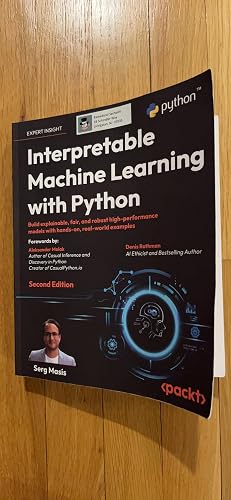
**** "Interpretable Machine Learning with Python - Second Edition," authored by Serg Masís and published by Packt, has garnered widespread acclaim for its comprehensive and practical approach to demystifying the complexities of machine learning model interpretation. The structure of the book, built around distinct "missions," enhances the reader's engagement by combining theoretical concepts with hands-on Python code and illustrative plots. Such an approach is particularly beneficial for both beginners and advanced practitioners, making the content accessible while also offering depth. One of the book’s key strengths lies in its emphasis on explainability, interpretability, and their implications for fairness and reliability in machine learning. Readers are introduced to essential terminologies and different model types, including black-box, white-box, and glass-box models. Practical applications, such as the exploration of bias in datasets, further emphasize the importance of understanding machine learning outcomes in real-world scenarios. The author masterfully bridges theory with application, illustrating how shortcomings in model interpretability can manifest in critical real-life decision-making processes. The breadth of topics covered, ranging from traditional methods of interpretation to complex architectures like convolutional neural networks and natural language processing, ensures that the book remains relevant in the fast-evolving landscape of machine learning. The included case studies and additional resources, such as the active Discord community, enhance learning by fostering collaboration and discussion among readers. This book not only serves as a foundational resource but also challenges practitioners to actively engage with interpretable machine learning tools, reinforcing the notion that understanding the "why" behind model decisions is paramount. With its combination of detailed explanations, practical examples, and strategic guidance on avoiding pitfalls, "Interpretable Machine Learning with Python" stands out as an essential read for anyone looking to grasp the intricacies of machine learning interpretation. **
Customer Reviews & Ratings
36 customers ratings
-
5 Star
78%
-
4 Star
12%
-
3 Star
6%
-
2 Star
0%
-
1 Star
4%
Review this product
Share your thoughts with other customers
Pros
- Structured approach with clear "missions" enhancing engagement.
- Comprehensive coverage of key interpretability concepts and tools.
- Practical applications with real-world case studies.
- Suitable for beginners and advanced readers alike.
- Active support community via Discord.
- Offers valuable insights into advanced topics like CNNs and NLP.
Cons
- Lengthy due to its ambitious scope, which may overwhelm some readers.
Related Brands
Product Price History
Important information
- Limitations : For products shipped internationally, please note that any manufacturer warranty may not be valid; manufacturer service options may not be available; product manuals, instructions, and safety warnings may not be in destination country languages; the products (and accompanying materials) may not be designed in accordance with destination country standards, specifications, and labeling requirements; and the products may not conform to destination country voltage and other electrical standards (requiring use of an adapter or converter if appropriate). The recipient is responsible for assuring that the product can be lawfully imported to the destination country. When ordering from Ubuy or its affiliates, the recipient is the importer of record and must comply with all laws and regulations of the destination country.
- Not all the products listed on Ubuy are for sale, as Ubuy is a global search engine. Products are subject to export/trade regulations.
€ 55
Order now and get it around Thursday, July 02
This item is not restrict in my country.(Please click on above link if this item is not restrict in your country, So our team will review and allow.)
QTY:
Secured transaction
Ubuy works hard to protect your security and privacy. Our advanced payment security system ensures confidentiality by encrypting your information during transmission using AES (Advanced Encryption Standards) and SSL (Secure Socket Layer) protocols. Your payment details are 100% secure as we do not share your payment details with third party sellers.
Our Top Logistics Partners
Fastest cross-border delivery
Features & Benefits
- Helps make machine learning models more robust, transparent, and fair
- Covers interpretability methods for white-box and black-box models
- Provides specific methods for deep learning models in vision, text, and time series domains
- Offers advice for companies using black-box models to prioritize transparency
- Focuses on explaining model decisions to uncover and mitigate biases
- Includes key features like SHAP, feature importance, and causal inference